
01
Case Assessment
Technical and regulatory initial assessment of the recovery case.
Approval-ready recovery path for critical aerospace parts.
Bringing parts that are no longer available back into a robust sourcing and approval path.
When data baseline, supplier, tooling or documentation no longer hold, this is not a pure sourcing problem. It becomes an airworthiness, configuration and industrialization problem.
Part Recovery builds the technical basis for that.
With clear configuration, robust documentation and a qualifiable manufacturing and inspection route.
Technical and regulatory initial assessment of the recovery case.
Clarification of data baseline, drawing status, characteristics and gaps.
Qualifiable manufacturing and inspection path for critical parts and assemblies.
Recommendation for a robust release and implementation path.
Cases become critical when supply source, design data, tooling, inspection characteristics or documentation chain are no longer stable. Classical sourcing is no longer enough. The bottleneck is restoring a robust technical basis. That is exactly where Part Recovery starts.
Legacy programs continue, but suppliers, drawings and manufacturing routes are no longer fully capable.
Without traceability, material picture and inspection logic, a spare part becomes a risk for program, audit and release.
New components, new environments or new requirements raise the burden on configuration, documentation and compliance.
In aerospace and aviation-related programs, five recurring recovery situations exist — each with its own recovery task.
A component is no longer available, but the decisive factor is the approved configuration state.
Assess the component against the actual configuration and documentation state.
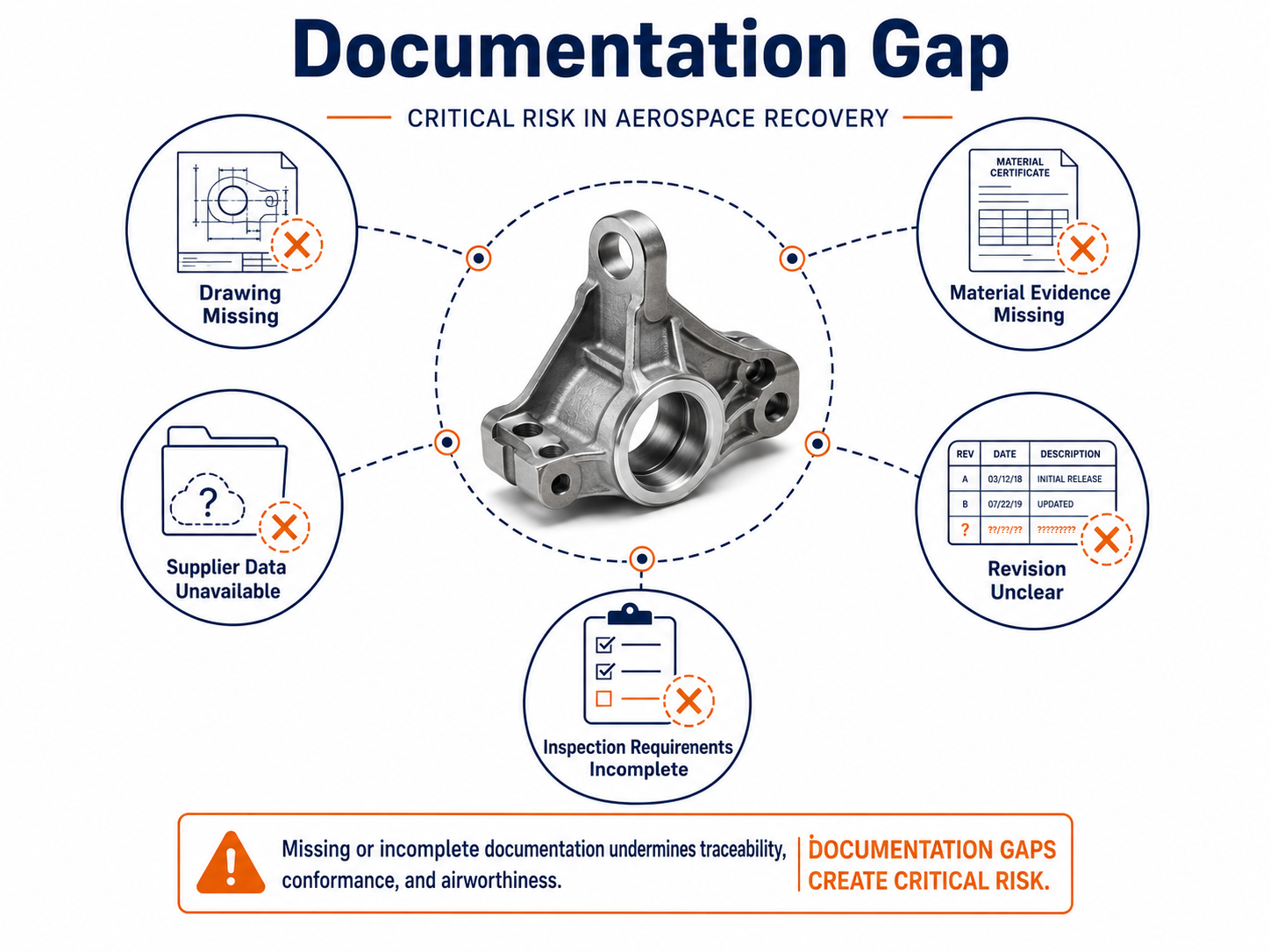
In aerospace, missing documentation is often more critical than missing production capacity.
Clarify the available data and identify the missing evidence required for a technically defensible path.
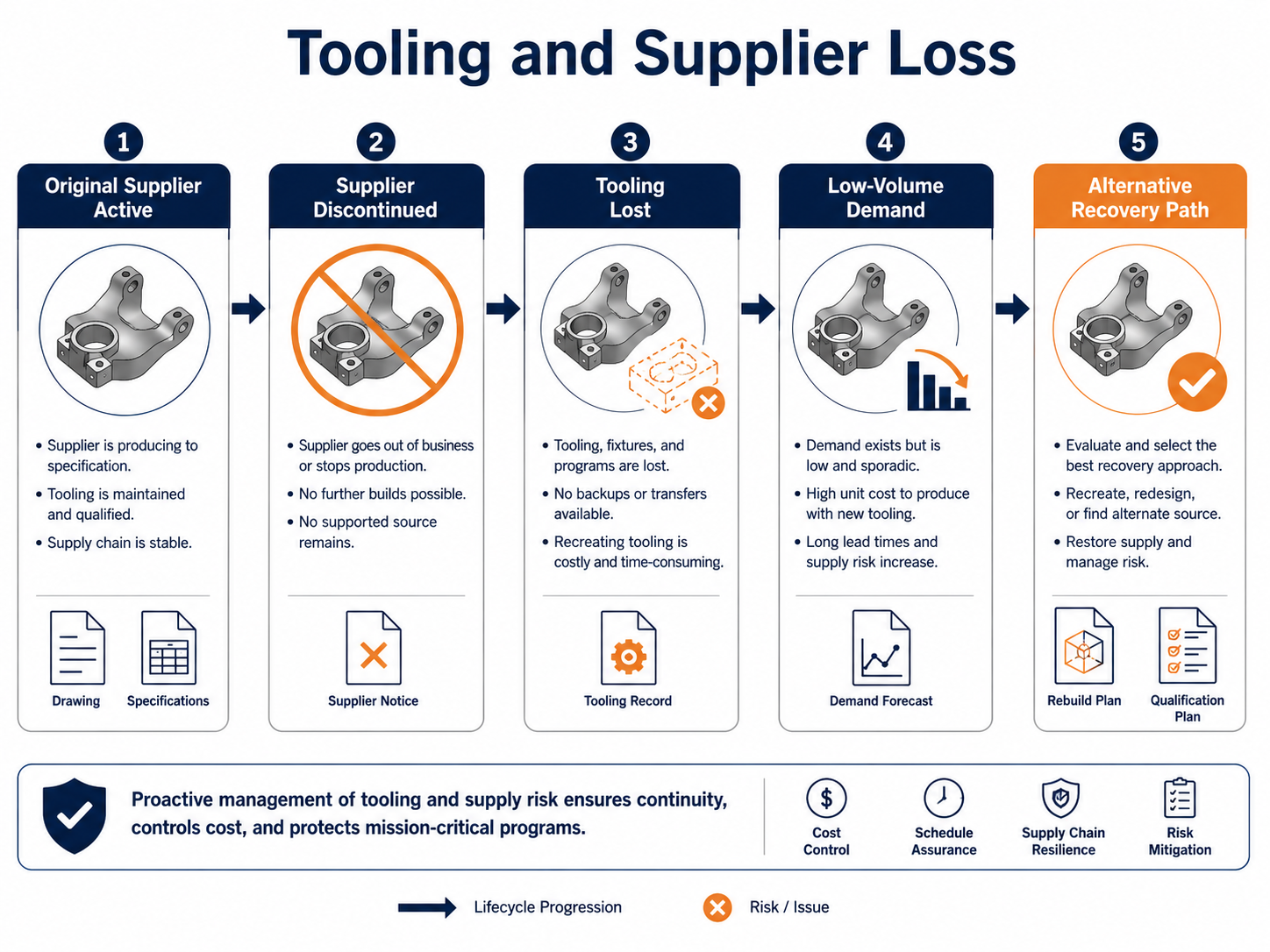
The original manufacturing route is no longer available.
Evaluate alternative manufacturing or repair paths without losing control of approval and documentation requirements.
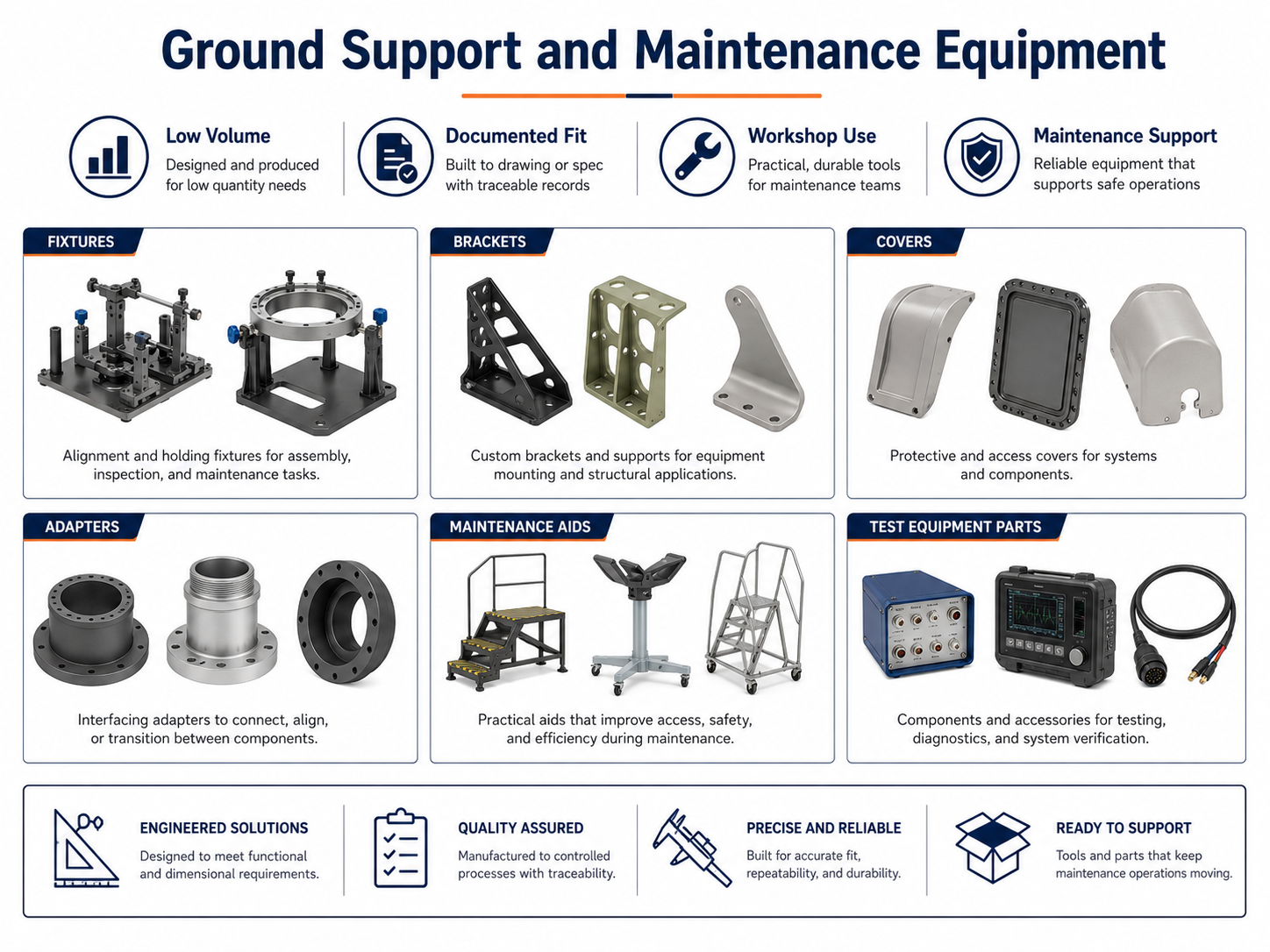
Many aerospace-related obsolescence cases concern non-flying components rather than primary flight hardware.
Restore functional, documented availability of maintenance and support components with low-volume efficiency.
Aerospace obsolescence often affects small quantities over long service periods.
Develop recovery paths for low-volume components with high demands on documentation, fit and traceability.
The offer is described as a clear output — not as a method.
Assessment of data baseline, traceability, configuration, risks and feasibility.
Building the technical basis from drawing, characteristics, materials, interfaces and inspection criteria.
Definition of manufacturing process, inspection concept, supply chain and production capability.
Recommendation for the robust path to implementation in the regulated environment.
Three component families cover the majority of aerospace recovery requests.
Critical: configuration relevance, documentation status, functional fit, low-volume economics.
Critical: material approval, ageing behaviour, geometry conformity, installation acceptance.
Critical: configuration, revision status, traceability, defensible recovery path.
Not technologies and methods first, but problem, risk, solution and result first.
In aerospace, the challenge is rarely manufacturing alone. The critical questions are:
Recovery is therefore driven by configuration, documentation and acceptance discipline.
Not by manufacturing freedom alone.
The question is not: Can someone make this part?
The aerospace-relevant question is: Can a recovery path be built that respects configuration, documentation, evidence and approval requirements?
PART RECOVERY supports this transition: from unavailable component to approval-ready recovery path.
Compact, commercial and program-near.