
01
Outage Case Assessment
Technical and regulatory initial assessment of the recovery case — within the outage window.
Outage-capable recovery path for critical energy components.
Bringing no-longer-available components back into a robust outage and return-to-service path.
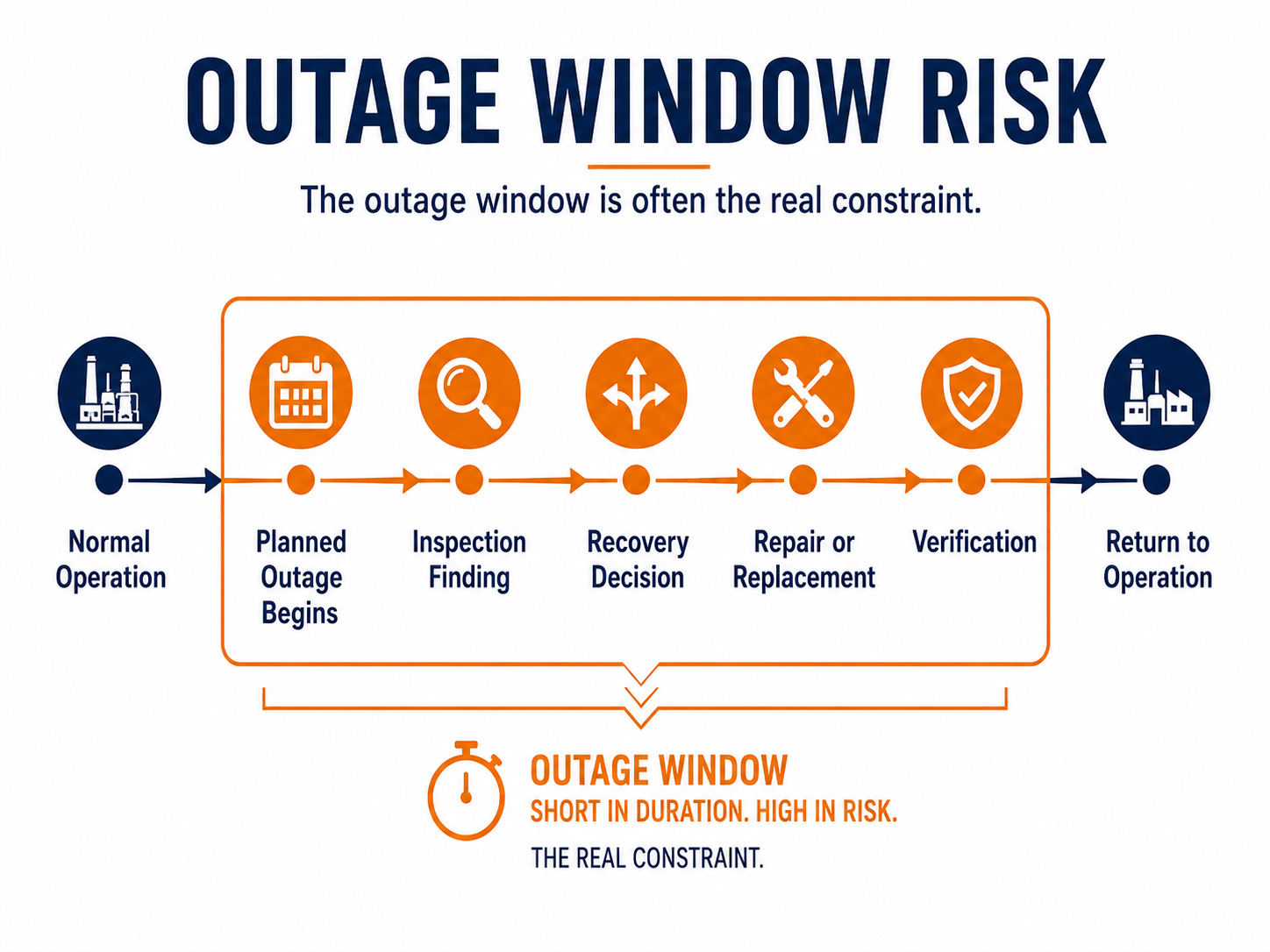
When supplier, data baseline, material evidence or documentation no longer hold, this is not a pure spare-parts problem. It becomes an outage, availability and return-to-service problem.
Part Recovery builds the technical basis for that.
With clear operating conditions, robust documentation and a qualifiable manufacturing and inspection route.
Technical and regulatory initial assessment of the recovery case — within the outage window.
Clarification of operating conditions, data baseline, critical zones and gaps.
Qualifiable manufacturing and inspection path for outage-relevant components.
Recommendation for a robust path back into regulated operation.
Cases become critical when supply source, material evidence, documentation or return-to-service foundation are no longer stable. Classical sourcing is no longer enough. The bottleneck is restoring an outage-capable technical basis.
A delayed restart shifts production, contracts and standby plans — not just a spare part.
Older power plants, substations and auxiliaries often operate beyond the OEM support window.
Wear, corrosion or damaged function surfaces only become visible during inspection — the recovery path must be ready fast.
Energy assets generate recovery requirements under very different conditions — five situations recur.
A component is only identified as damaged, worn or unusable during inspection.
Create a controlled path from inspection finding to operational component without losing the outage plan.
Many energy assets operate beyond the original supplier support window.
Support continued operation where the asset is still valuable but the original supply chain is no longer reliable.
Energy components often fail at specific function zones — not the whole part.
Identify the function-critical zone and restore it specifically — instead of treating the component as a pure geometry problem.
Energy assets combine mechanical, thermal and environmental loads.
Adapt the recovery strategy to the real operating environment.
Older energy assets often suffer from incomplete data.
Build the technical evidence required for a robust decision.
The offer is described as a clear output — not as a method.
Assessment of data baseline, operating conditions, risks and feasibility within the outage window.
Building the technical basis from geometry, material, function zones and inspection criteria.
Definition of manufacturing process, inspection concept and delivery path — matched to the maintenance window.
Recommendation for the robust path back into regulated operation.
Three component families cover the majority of recovery enquiries in the energy sector.
Critical: fit, balancing, wear, sealing function, vibration and material condition.
Critical: temperature, pressure limit, corrosion, sealing function and documentation.
Critical: fit, insulation, IP rating, weather, access and approval path.
Not technologies and methods first, but problem, risk, solution and result first.
The question is not: Can someone reproduce this component?
The question is: Can the component be restored such that reliable operation, documented decision and return-to-service are supported?
PART RECOVERY supports this transition: from the obsolete energy component to an outage-ready recovery solution.
Compact, outage-oriented and operations-near.