PART RECOVERY
Industry · Heavy Equipment

Heavy Equipment Part Recovery

When a missing component stops productive capacity.

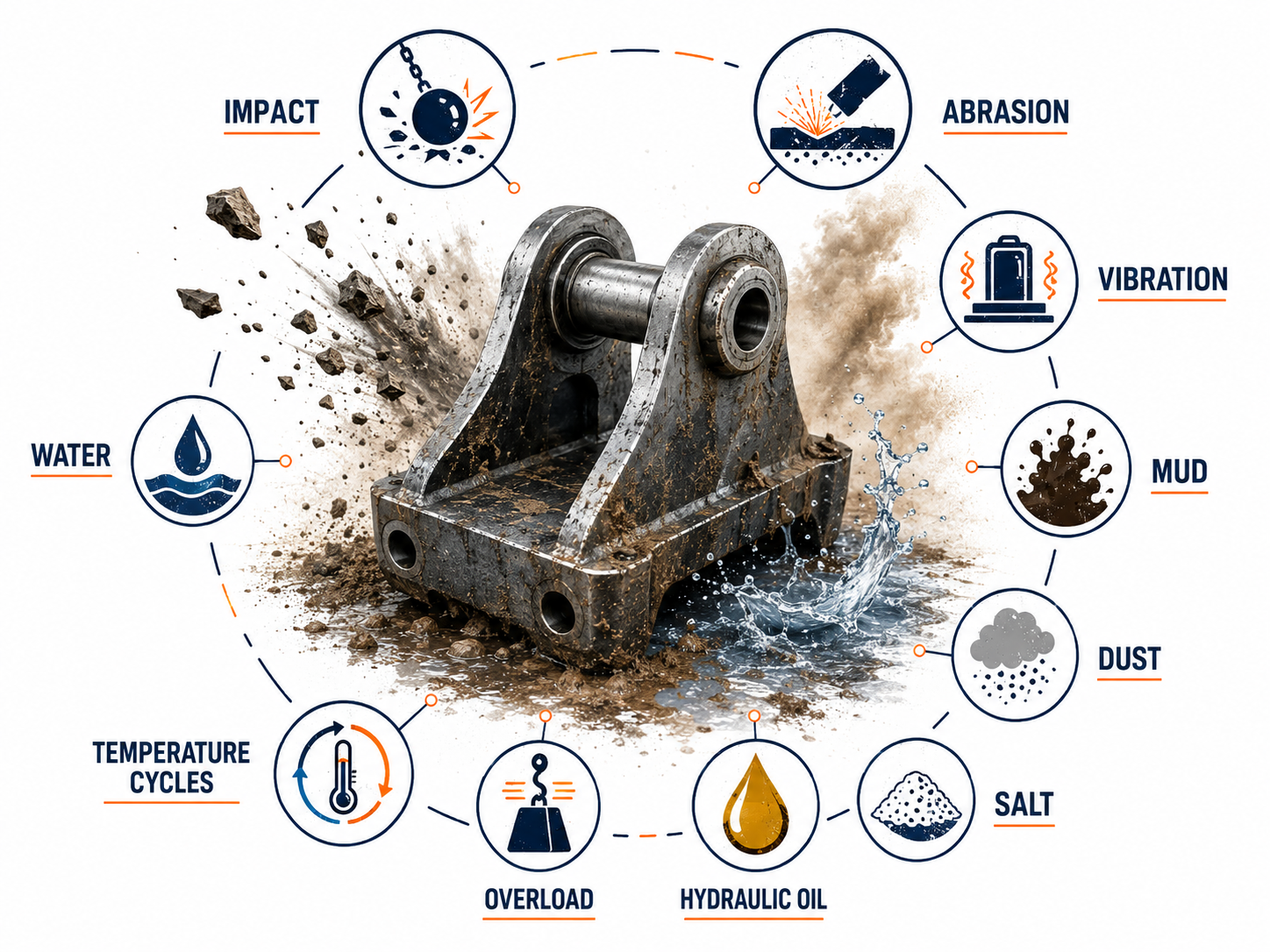
Heavy equipment does not fail in theory. It fails in mud, dust, vibration, impact, corrosion, overload, hydraulic leaks and field repairs.

When a missing component stops productive capacity.

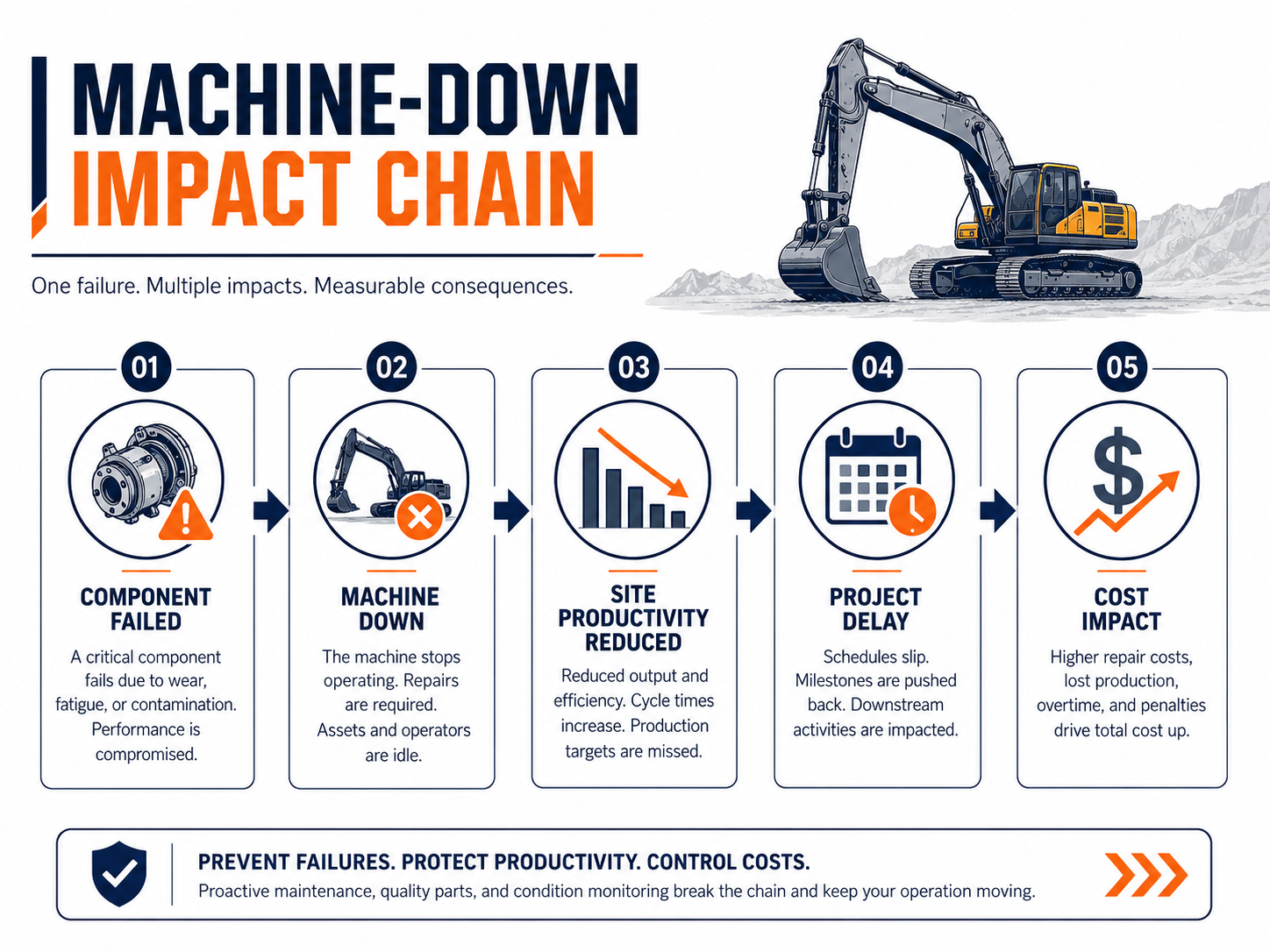
A missing or damaged component can immobilise a machine, delay a project, block production or force expensive emergency procurement.

PART RECOVERY supports owners, operators, dealers and maintenance organisations when machine-specific components are no longer available, no longer documented or no longer economically obtainable.

Not as spare-parts trade.

Not as a manufacturing process.

As a recovery partner for heavy-equipment components where fit, wear, load, repair history and operating conditions determine the solution.

Recovery starts at the machine

Heavy Equipment Recovery starts with the machine reality.

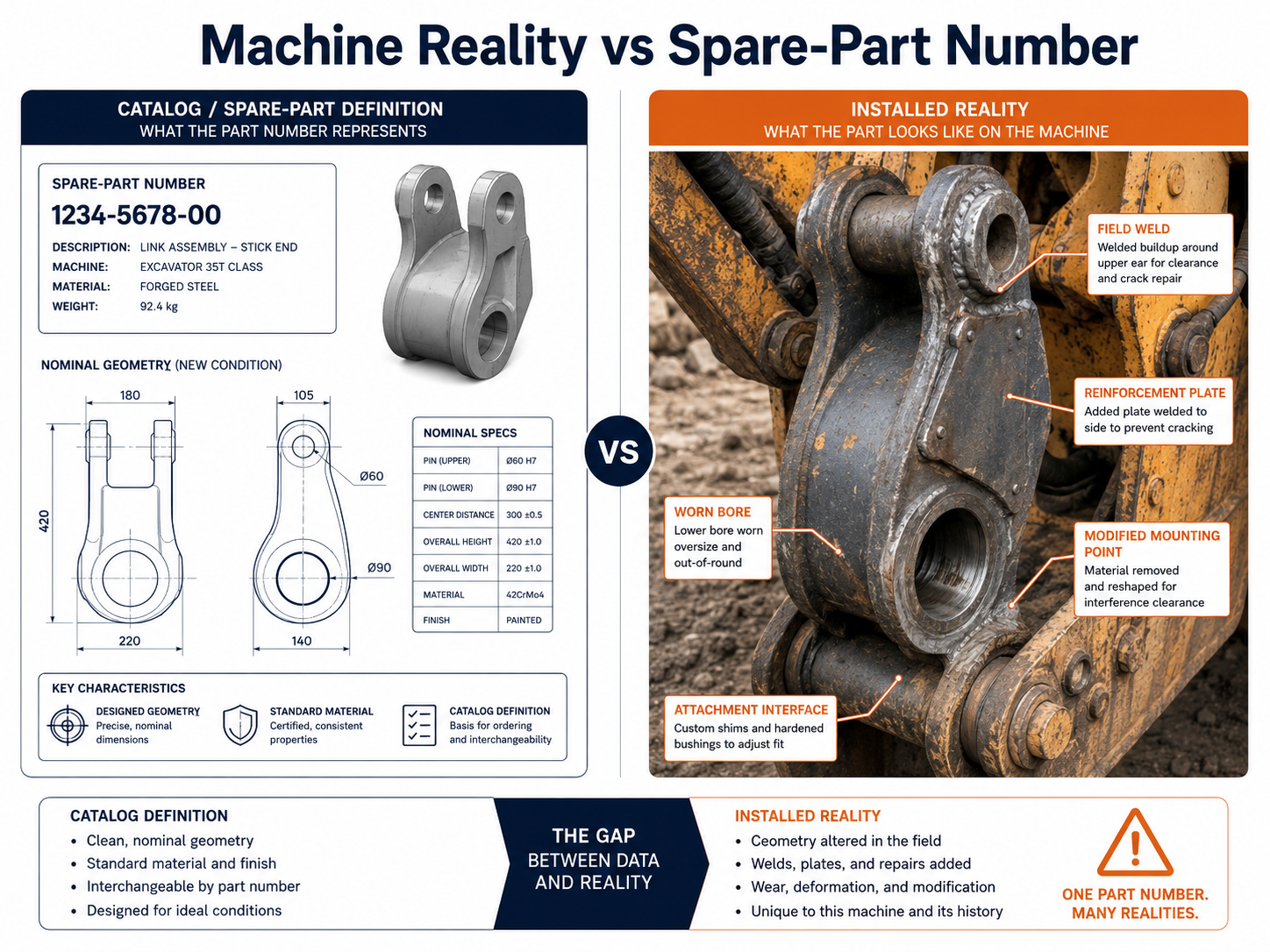
For heavy equipment, the drawing is rarely the whole truth.

Heavy Equipment Recovery starts with the machine reality.
The real machine may contain:
  • field repairs
  • welded modifications
  • reinforced brackets
  • worn interfaces
  • changed attachment points
  • hydraulic adaptations
  • serial-number-specific variants
  • aftermarket parts
  • undocumented repairs
  • warped or damaged structures

That is why recovery must start with the installed reality — not just with the original part number.

Recovery situations

Five heavy-equipment-specific recovery situations

In the heavy-equipment environment, five recovery situations recur, each with its own recovery task.

Five heavy-equipment-specific recovery situations

1. Machine-down: component loss

A machine is stopped because a specific component is unavailable.

Typical cases
  • broken bracket
  • damaged housing
  • worn bearing seat
  • unavailable cover
  • failed adapter
  • missing guard
  • damaged linkage part
Recovery task

Restore availability quickly enough to support machine uptime.
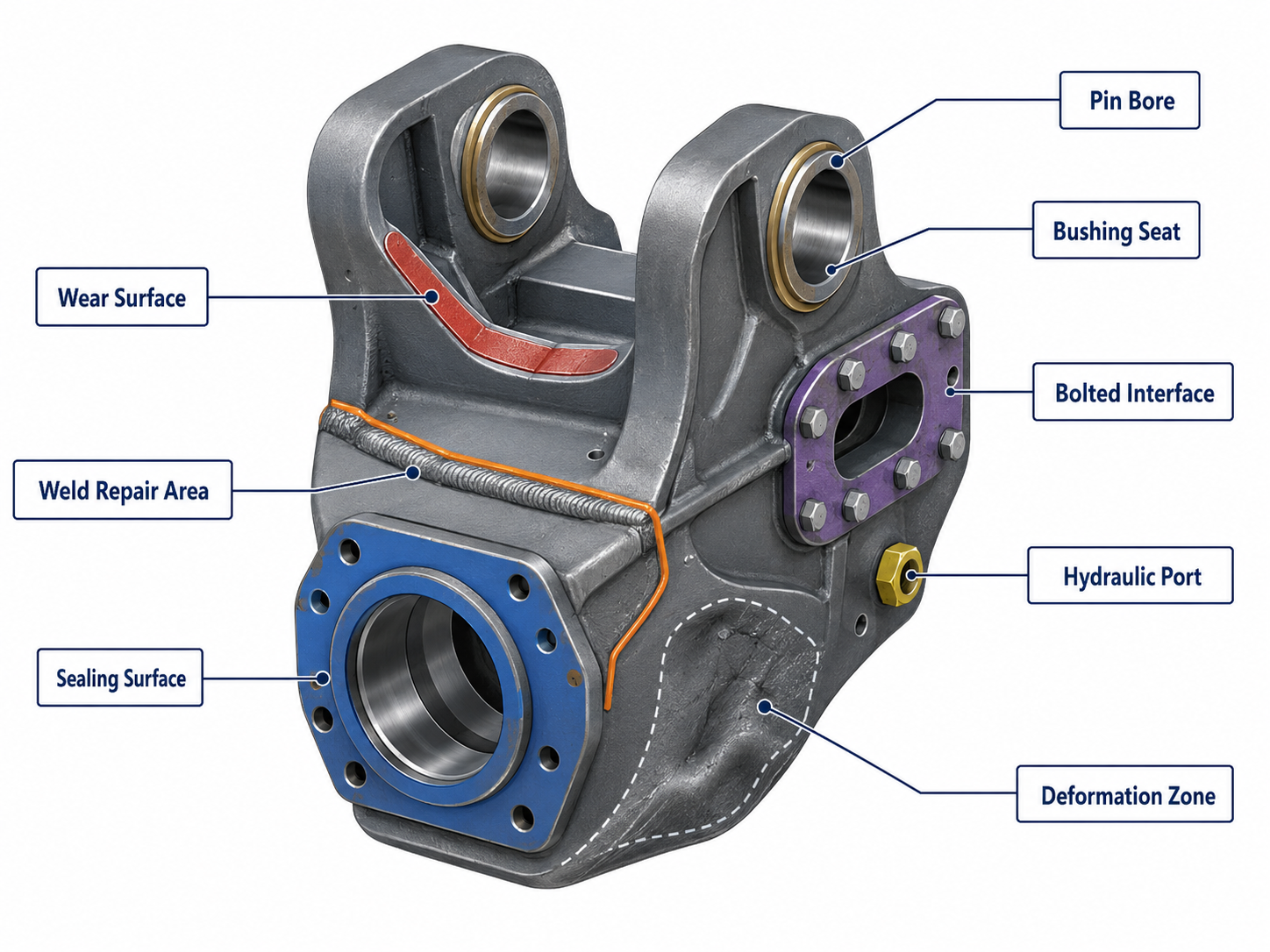
2. Failure at wear interfaces

Many heavy-equipment parts do not fail as complete components — they fail at interfaces.

Typical critical zones
  • pin bores
  • bearing seats
  • bushings
  • sealing surfaces
  • hydraulic connections
  • bolted interfaces
  • wear plates
  • sliding surfaces
Recovery task

Identify the function-critical zone and restore it specifically — instead of unnecessarily replacing the entire component.

3. Variant and attachment mismatch

Heavy-equipment fleets often contain multiple machine generations, attachments and field modifications.

Typical cases
  • same model, different serial number
  • differing attachment geometry
  • modified mounting points
  • non-standard adapter plates
  • aftermarket systems
  • regional machine variants
Recovery task

Restore the component against the actual machine configuration.

4. Loss of supplier and tooling

For older machines, the original component may no longer be available.

Typical cases
  • OEM part discontinued
  • casting unavailable
  • rubber mould lost
  • supplier no longer active
  • minimum order quantity too high
  • long lead time incompatible with machine downtime
Recovery task

Define a practical recovery route that suits the machine, the load case and the required service life.

5. Wear from harsh environment

Heavy-equipment components operate in conditions that accelerate damage.

Typical influences
  • impact
  • abrasion
  • vibration
  • mud
  • dust
  • water
  • salt
  • hydraulic oil
  • temperature cycles
  • improper lubrication
  • overload
Recovery task

Adapt the recovery strategy to real operating exposure — not just to nominal design data.

Recovery by component group

Typical recovery candidates

Three component families cover the majority of recovery enquiries in the heavy-equipment sector.

Typical recovery candidates

Structural and mechanical parts

Typical parts
  • brackets
  • mounts
  • linkages
  • guards
  • housings
  • adapter plates
  • covers
  • bearing supports

Critical: load path, fit, deformation, welding history, fatigue load and repairability.

Wear and interface parts

Typical parts
  • pin bores
  • bushing seats
  • wear plates
  • sliding guides
  • sealing surfaces
  • hydraulic interfaces
  • flanges

Critical: surface condition, geometry, material, hardness, lubrication and wear mechanism.

Polymer and elastomer parts

Typical parts
  • seals
  • grommets
  • bellows
  • protective covers
  • rubber buffers
  • dust protection parts
  • moulded rubber parts

Critical: oil resistance, abrasion, ozone, temperature, compression set and installation geometry.

Preparation instead of reaction

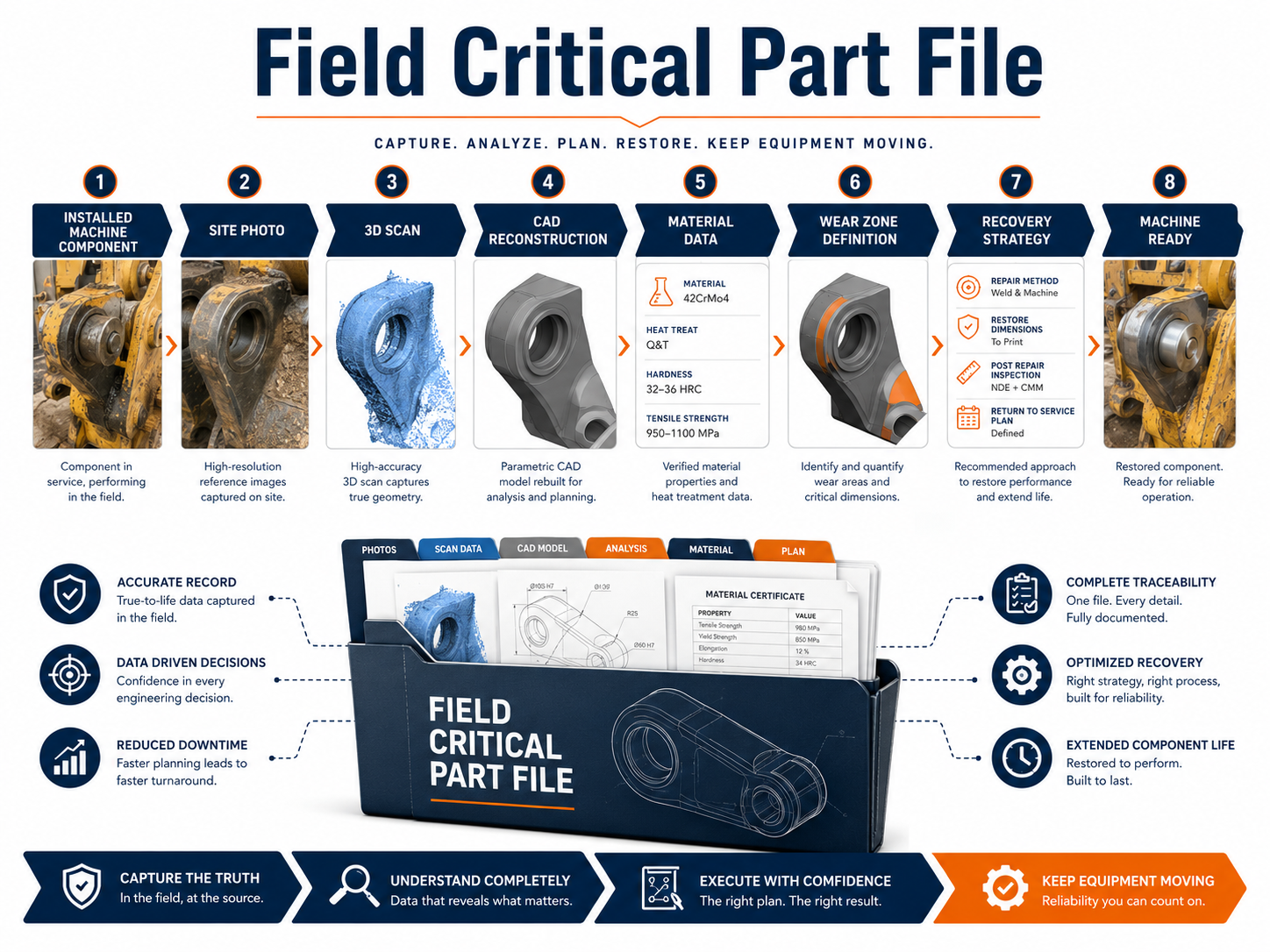
Field Critical Part File

For selected machines or components, recovery can be prepared before failure. A Field Critical Part File bundles the necessary information.

Field Critical Part File
A Field Critical Part File may contain
  • machine and serial-number context
  • photos of the installed component
  • 3D scan
  • CAD reconstruction
  • material information
  • critical interfaces
  • definition of the wear zone
  • repair history
  • possible recovery strategy
  • reference sample
  • installation restrictions

The goal is not stock.

The goal is recovery readiness for machine-critical parts.

Prioritisation

Which parts should be prepared?

Good candidates are components with the following characteristics.

high machine-downtime impact
long lead time
low annual demand
machine-specific geometry
repeated wear damage
unclear documentation
missing tooling
expensive complete replacement
difficult access
history of field repairs
The right scale

The question is not: Can someone make this part?

The heavy-equipment question is: Can the component be restored so that the machine can return to productive work under real operating conditions?

PART RECOVERY supports this transition: from the unavailable or damaged component to a machine-ready recovery solution.

Recovering critical components starts with an assessment.

Start the Recovery Check or request an Expert Review. We respond within one business day.