
PART RECOVERY
Industry · Marine & Offshore

Marine & Offshore Part Recovery

When the ship is available, the part has to be ready.

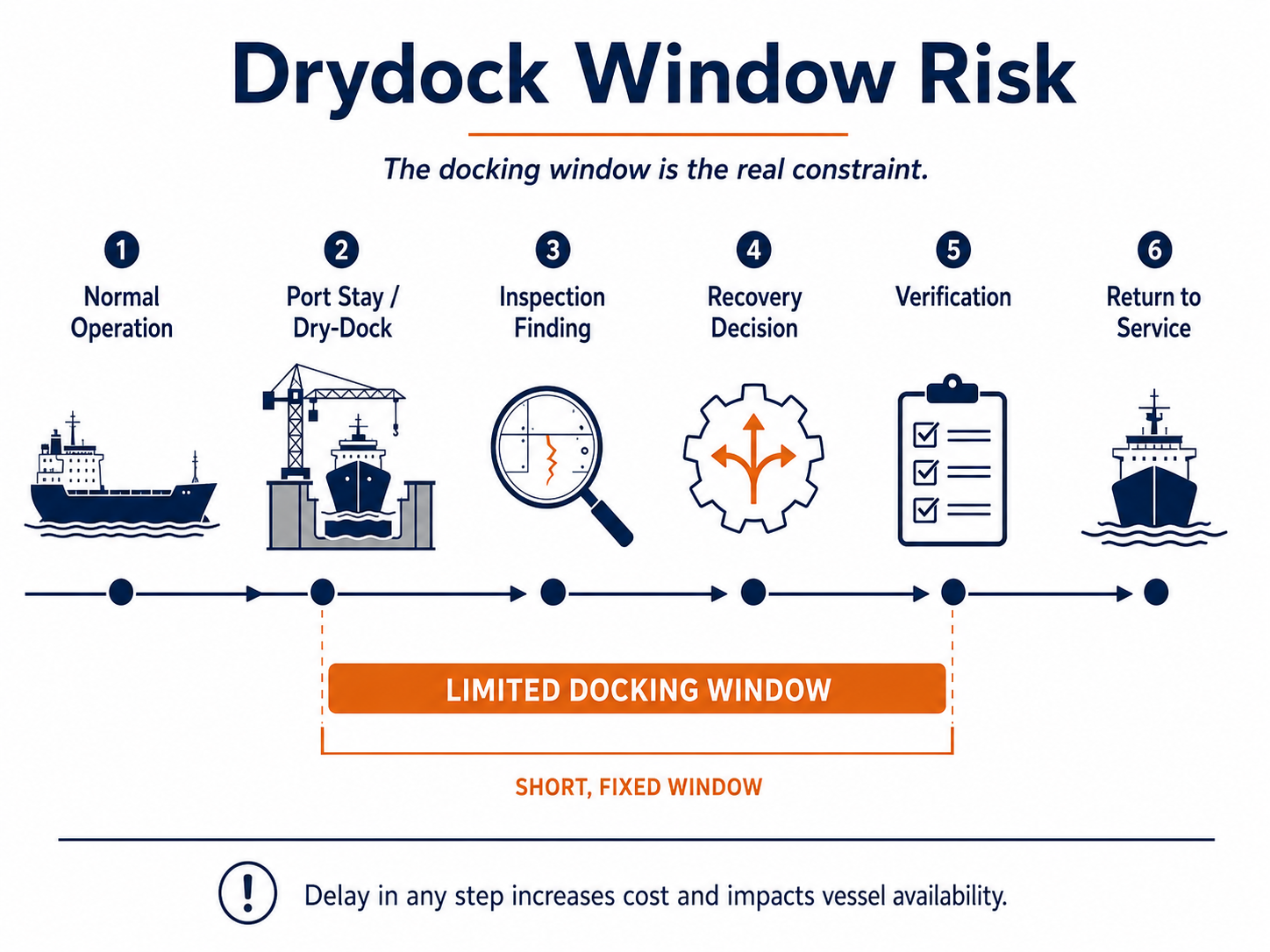
In maritime operation, component availability often depends on tight operational windows. A ship is often only accessible during port time, planned maintenance or docking.

When the ship is available, the part has to be ready.

When a component becomes obsolete, damaged or no longer sufficiently documented, the problem quickly grows beyond pure procurement.

It affects vessel availability, docking plans, class-relevant documentation and operational continuity.

PART RECOVERY supports owners, fleet managers, technical superintendents, shipyards and offshore operators when ship-specific components are no longer available, no longer reproducible or no longer sufficiently documented.

Not as spare-parts trade.

Not as a manufacturing process.

As a recovery partner for marine components where function, material, environment, documentation and acceptance must be considered together.

Recovery starts on board

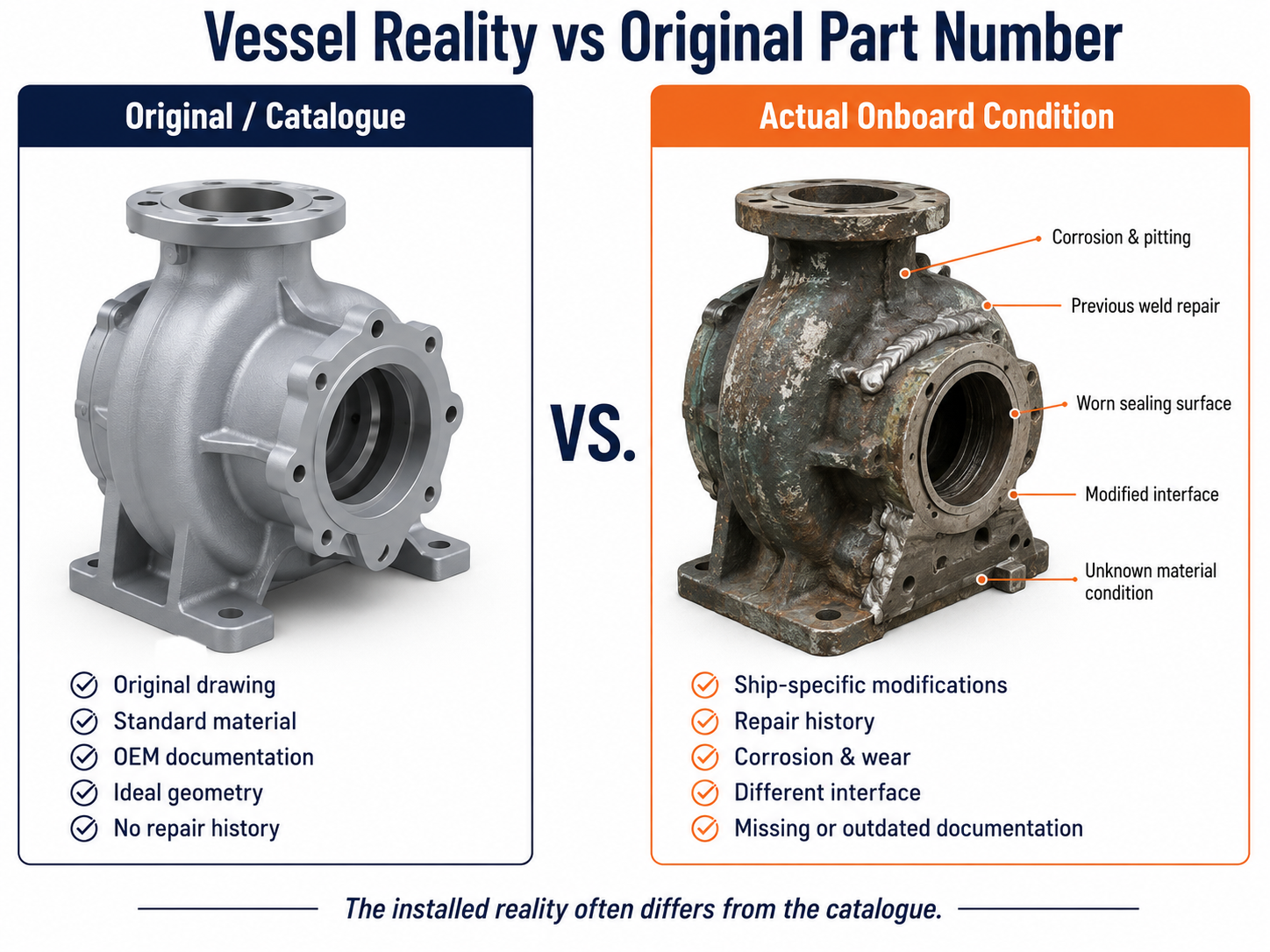
Marine Recovery starts with the installed reality.

A ship component is rarely defined by a part number alone.

Marine Recovery starts with the installed reality.
The real situation on board may include:
  • ship-specific modifications
  • previous repair history
  • corrosion damage
  • worn interfaces
  • obsolete supplier documentation
  • class-relevant inspection requirements
  • limited access during port time
  • dry-dock time restrictions
  • local installation restrictions
  • non-identical sister vessels
  • undocumented on-board adaptations

Recovery must therefore start with the real component and its actual operating environment.

Not with the catalogue assumption.

Recovery situations

Five marine-specific recovery situations

In the maritime environment, five recovery situations recur — each with its own recovery task.

Five marine-specific recovery situations

1. Dry-dock finding

A component is recognised during inspection as damaged, worn or unusable.

Typical cases
  • corroded housings
  • damaged covers
  • worn bearing seats
  • damaged sealing surfaces
  • obsolete pump or valve parts
  • unavailable rubber or polymer components
  • undocumented previous repairs
Recovery task

Create a controlled path from the inspection finding to an operational component — without losing the docking window.
2. Saltwater and corrosion

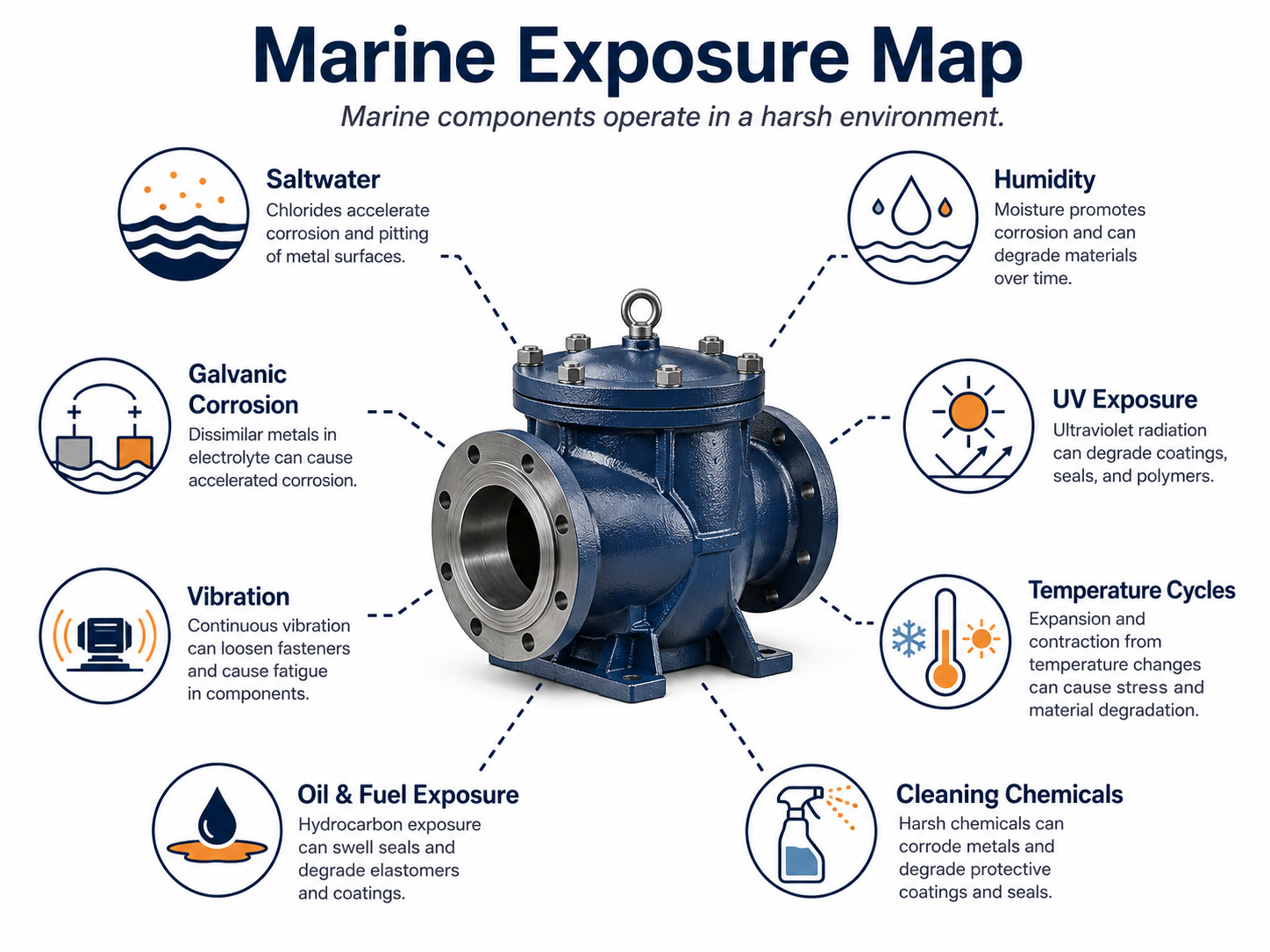
Marine components operate in an aggressive environment.

Typical influences
  • saltwater
  • humidity
  • galvanic corrosion
  • temperature cycles
  • UV load
  • vibration
  • cleaning chemicals
  • oil and fuel contact
  • abrasive particles
  • biofouling
Recovery task

Select and document a recovery strategy that reflects real maritime exposure — not only the original geometry.

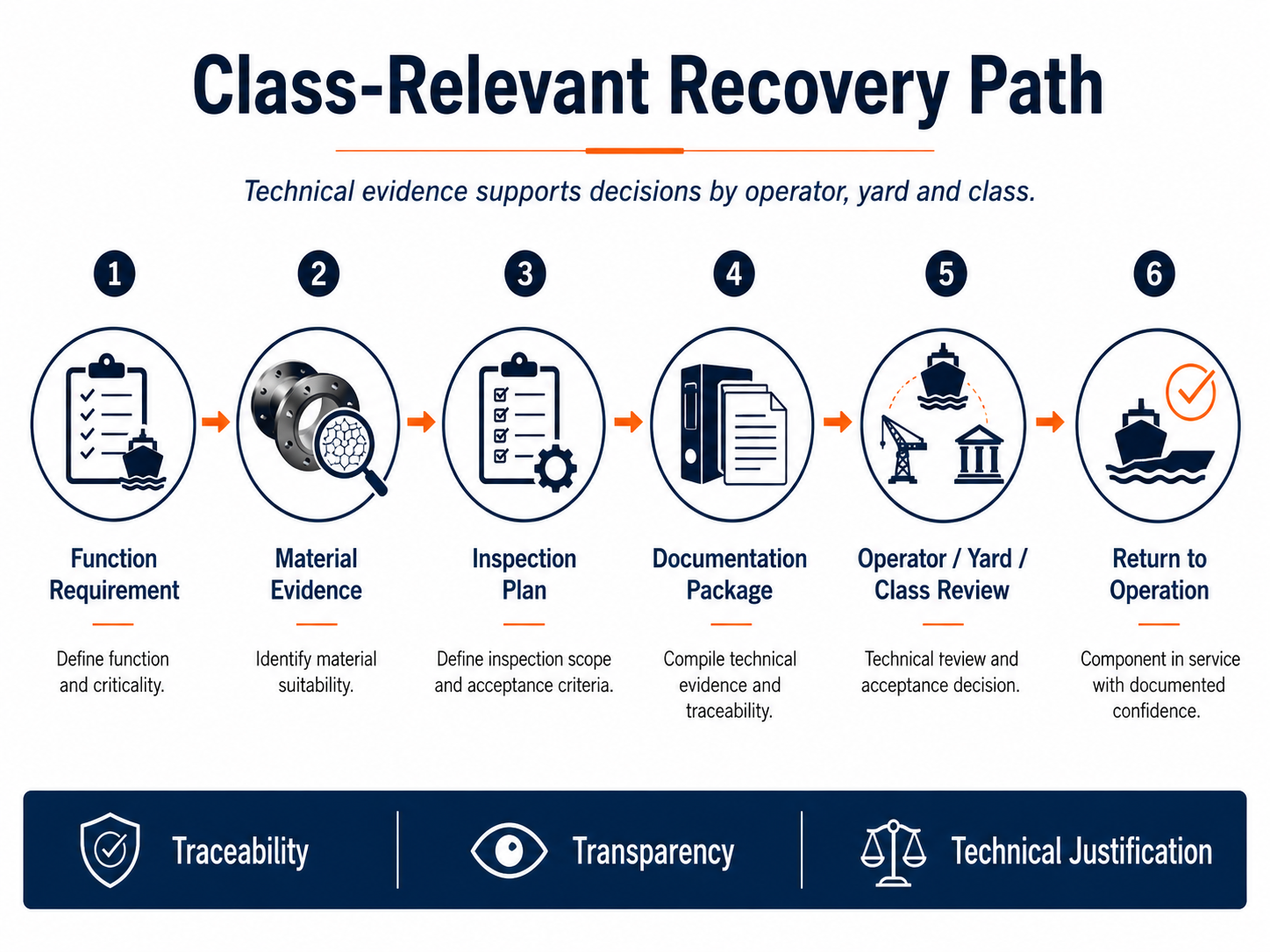
3. Class and acceptance relevance

For many maritime assets, the technical question is linked to inspection, documentation or class acceptance.

Typical cases
  • missing material evidence
  • unclear repair history
  • obsolete OEM documentation
  • unknown material class
  • pressure- or safety-relevant components
  • incomplete inspection records
  • modified parts without clean documentation
Recovery task

Prepare the technical evidence required for review by operator, shipyard, OEM or class-related decision processes.

4. Ship-specific configuration

Sister vessels are often not identical after years in service.

Typical cases
  • different retrofit state
  • shipyard-specific modifications
  • on-board repairs
  • alternative supplier parts
  • modified pipe or cable routes
  • local reinforcements or adaptations
  • non-standard interfaces
Recovery task

Restore the component against the actual ship configuration — not against the original design assumption.

5. Offshore and remote operations

For offshore assets the supply problem is aggravated by access, logistics and downtime cost.

Typical cases
  • platform-specific components
  • offshore handling restrictions
  • long logistics chains
  • limited intervention windows
  • obsolete hydraulic or mechanical parts
  • special seals, guards, adapters or housings
Recovery task

Improve technical readiness before component unavailability becomes an offshore downtime problem.

Recovery by component group

Typical recovery candidates

Three component families cover the majority of recovery enquiries from the maritime sector.

Pump, valve and fluid-system components

Typical parts
  • pump housings
  • covers
  • impeller-near components
  • valve bodies
  • valve seats
  • flanges
  • adapters
  • mechanical-seal carriers

Critical: media contact, corrosion, pressure, sealing surfaces, material evidence and inspection requirements.

Mechanical and structural interface parts

Typical parts
  • brackets
  • mounts
  • hinges
  • levers
  • covers
  • guards
  • adapter plates
  • mechanical housings
  • bearing supports

Critical: fit, load path, corrosion, vibration, welding history, deformation and access restrictions.

Polymer, rubber and sealing components

Typical parts
  • seals
  • bellows
  • cable grommets
  • rubber profiles
  • protective covers
  • moulded rubber parts
  • vibration dampers

Critical: saltwater, oil, fuel, UV, ozone, temperature, compression set and real installation geometry.

Preparation instead of reaction

Marine Critical Part File

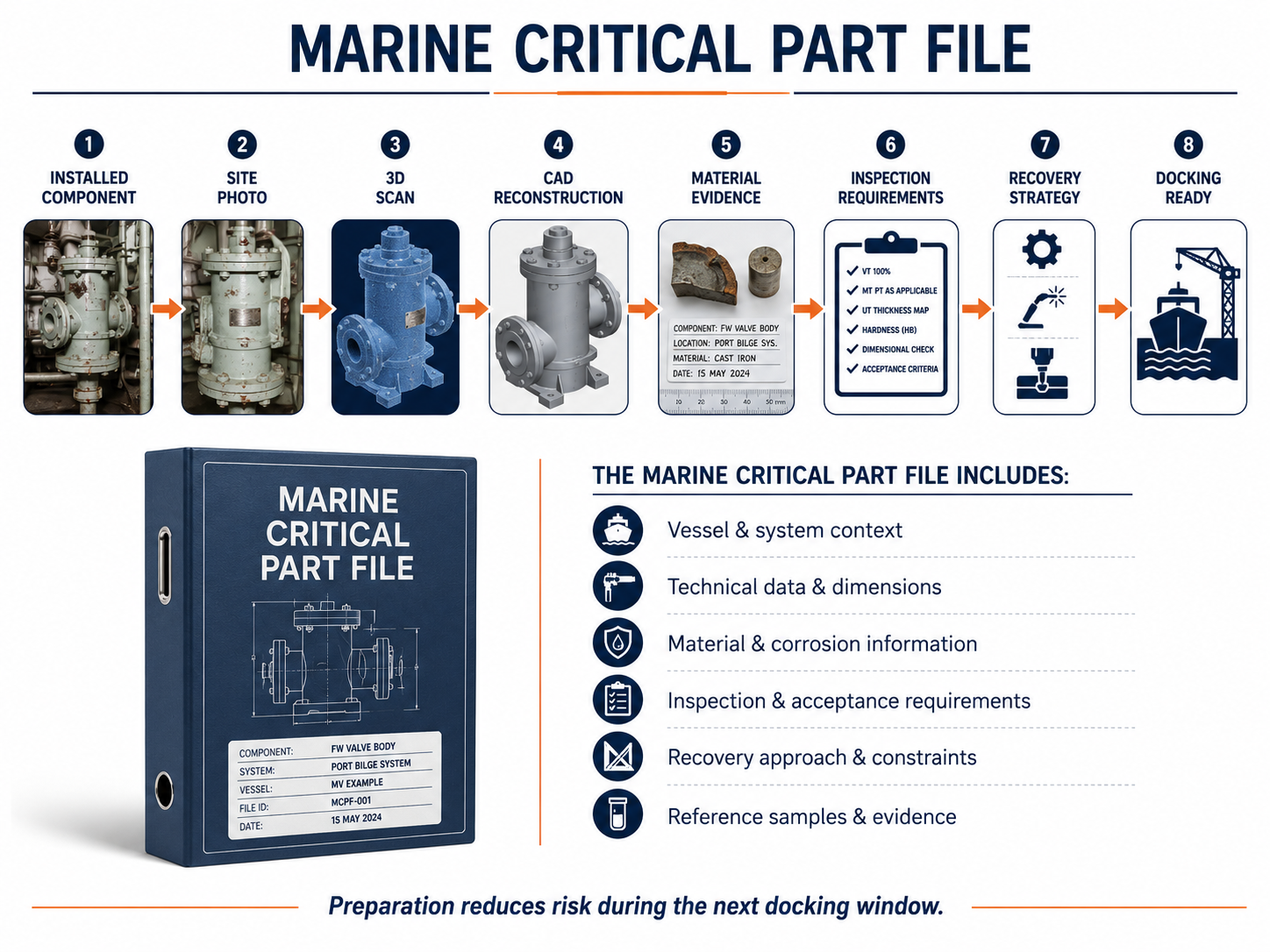
For selected ship or offshore components, recovery can be prepared before the next docking or maintenance window. A Marine Critical Part File bundles the necessary information.

Marine Critical Part File
A Marine Critical Part File may contain
  • ship and system context
  • photos of the installed component
  • 3D scan
  • CAD reconstruction
  • material information
  • documentation of corrosion and wear zones
  • critical interfaces
  • inspection requirements
  • possible recovery strategy
  • reference sample
  • documentation for operator, shipyard or class-related review

The goal is not stock.

The goal is docking readiness.

Prioritisation

Which components should be prepared?

Good candidates are components with the following characteristics.

Which components should be prepared?
high impact on vessel availability
long lead time
inactive or unknown supplier
ship-specific geometry
recurring corrosion or wear damage
missing drawings
missing material evidence
class-related relevance
difficult access
high consequence in case of delayed departure
The right scale

The question is not: Can someone reproduce this component?

The maritime question is: Can this component be restored so that vessel availability, inspection readiness and recommissioning within the available maintenance window are supported?

PART RECOVERY supports this transition: from the unavailable or damaged maritime component to a vessel-ready recovery solution.

Recovering critical components starts with an assessment.

Start the Recovery Check or request an Expert Review. We respond within one business day.